
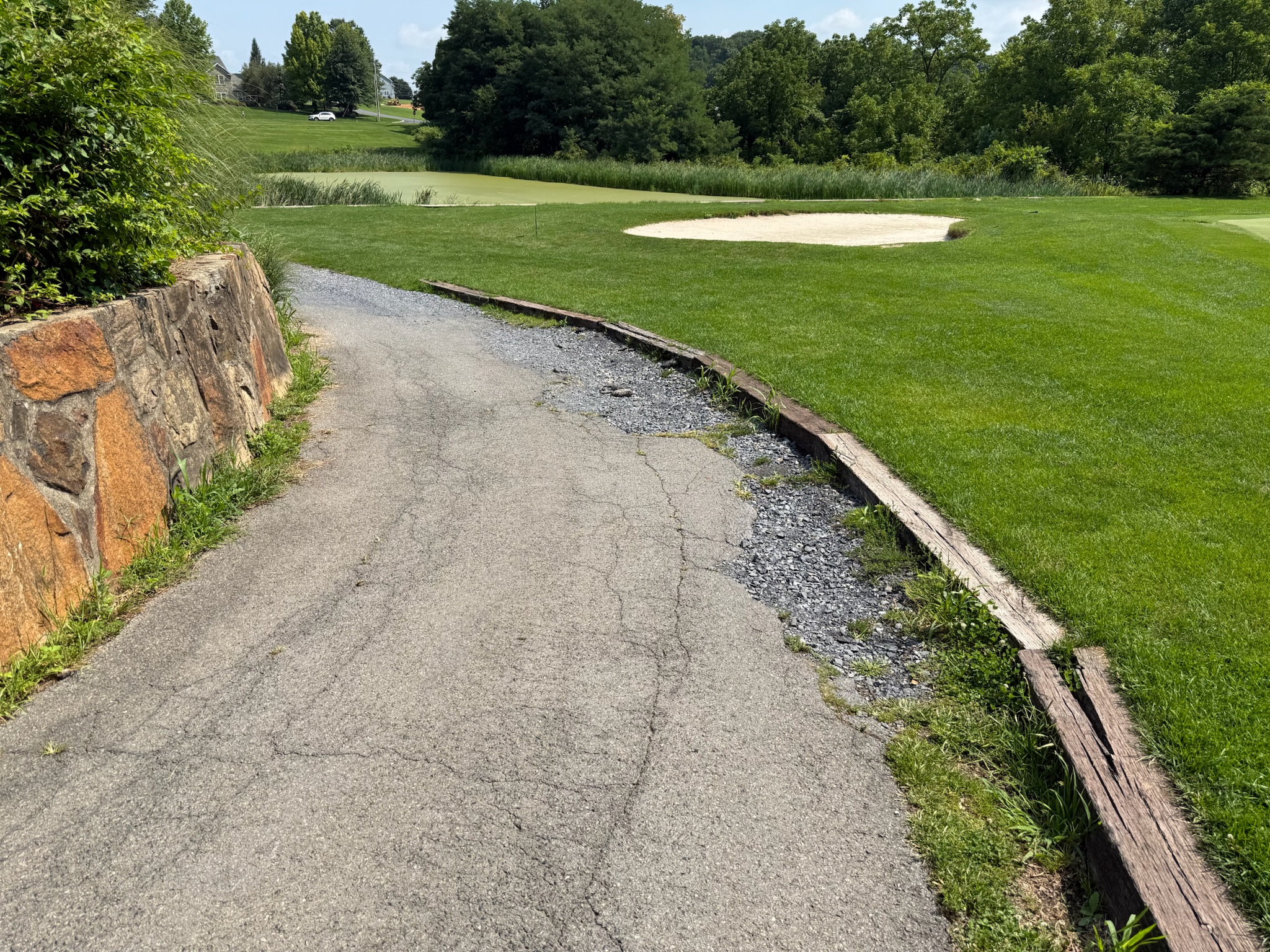

Deferred maintenance, as I wrote early last year can be a golf course’s best friend in certain situations. However, it can also signal a big capital/value impact and needs to be accurately understood.
Deferred maintenance is defined in The Dictionary of Real Estate Appraisal – 7th Edition as: “Items of wear and tear on a property that should be fixed now to protect the value or income-producing ability of the property, such as a broken window, a dead tree, a leak in the roof, or a faulty roof that must be completely replaced. These items are almost always curable. The key phrase here is should be “fixed now”. What this means is they need to be addressed now (as of the date of appraisal) which would likely result in a deduction from value of the cost to cure the item.”
What does this mean relative to the value of your golf property?
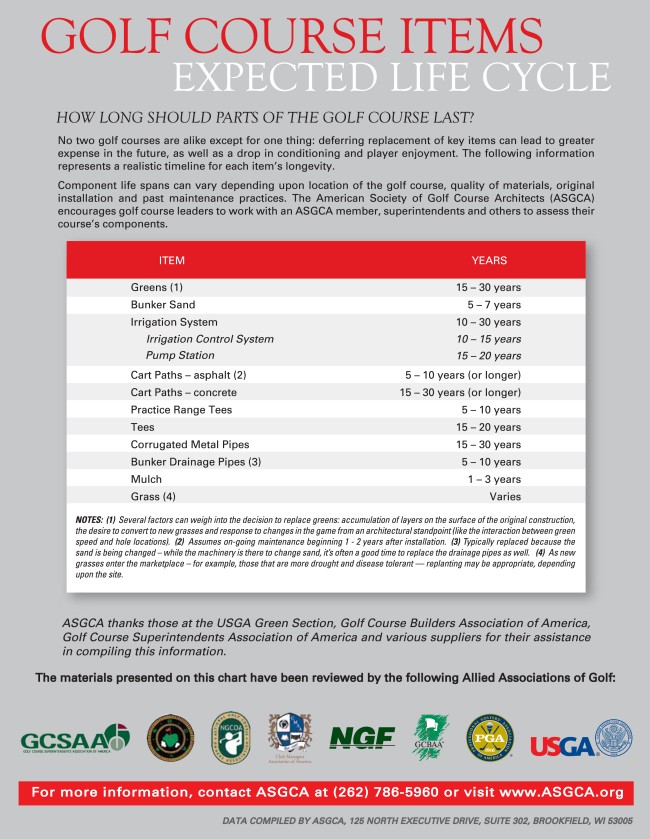
As we all know, golf courses (like other forms of real estate) have components that wear out. In particular, irrigation systems, cart paths and bunkers are typically the first places (on course) that show evidence of deferred maintenance. Of course, there are other areas of the golf course, as shown in the ASGCA life span chart, as well as building elements (roof, HVAC, kitchen equipment, etc.), site infrastructure (paving, utilities) and amenities (pool, tennis courts, etc.) that can exhibit deferred maintenance. It is not considered deferred maintenance if a club simply seeks to enhance or expand facilities that are otherwise functional.
Most prudently managed facilities establish reserve funds, to which money is contributed regularly to fund the replacement of elements as needed. This is done in the form of a “sinking fund” which is calculated to establish adequate funding for replacement when such replacement is anticipated. In an income/expense pro forma, these funds are categorized as an annual expense (Reserves/Capex) and factor into the analysis accordingly. Many private clubs require members to pay “capital dues” for this purpose. Conversely, deferred maintenance, identified above as “should be fixed now” is estimated as a cost to correct and ultimately deducted from the analysis to result in the estimated market value of the property.
The nuance in all this is the market. I’ve been told by some buyers that when pursuing properties in an environment perceived as a “sellers” market where there is often competition for acquisitions, they may underwrite their potential acquisition differently and spread the cost of some items over time, preferring to “patch” some problems in order to enable paying enough for the property to win the deal. In those environments perceived as “buyers” markets where the seller may be more motivated, buyers may be more likely to insist on adjusting for the cost to cure any items of deferred maintenance in negotiations.
Deferred maintenance most definitely impacts market value, but as shown market conditions affect how. When we do appraisals, depending on how the appraisal is to be used (financing, tax assessment, eminent domain, IRS status conversions or purchase & sale) various levels of documentation of deferred maintenance may be required. Knowing when and how to address these items can be part of any strategy depending on the mission at hand.
