

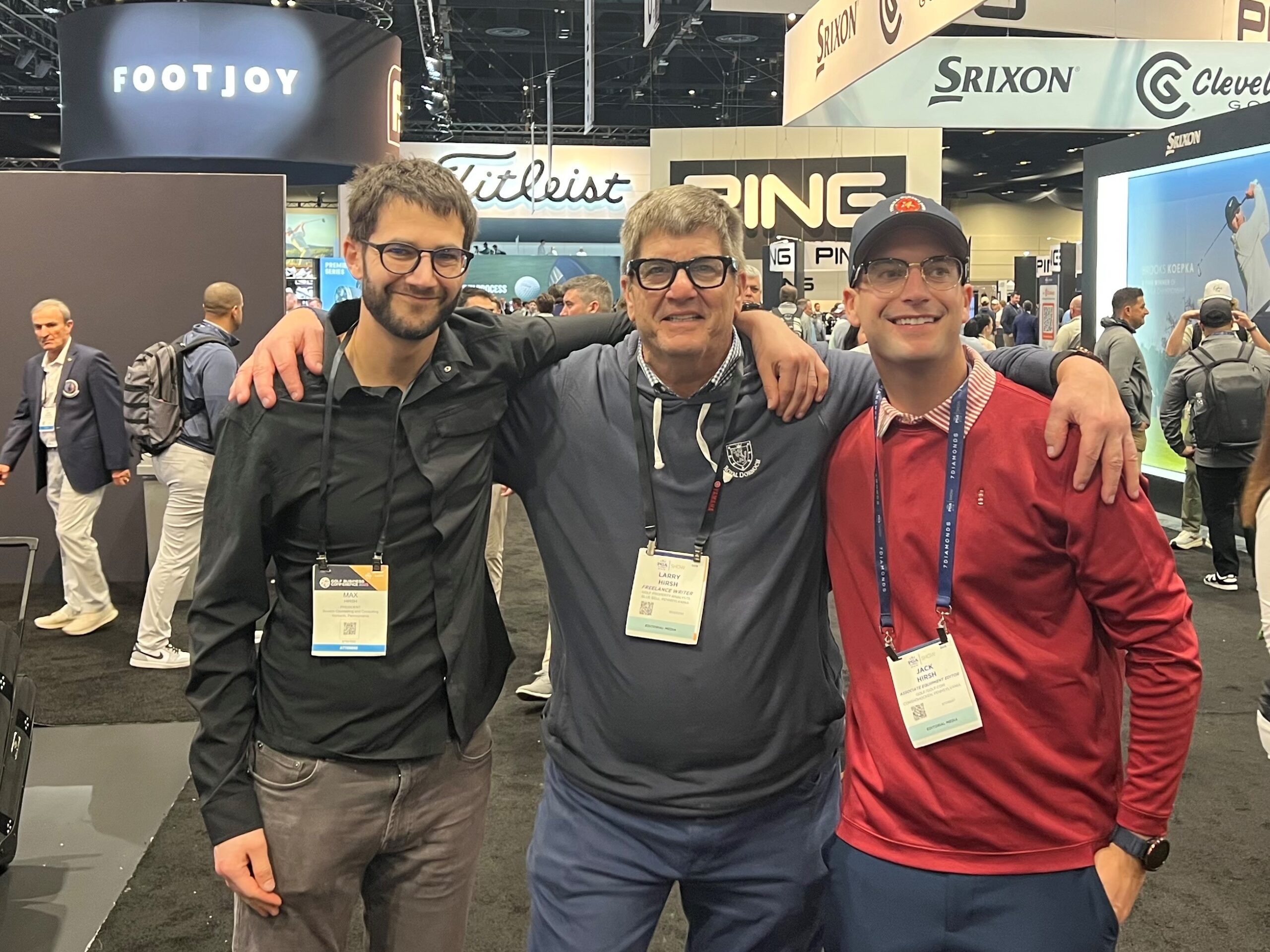
Among the cool things in life is getting to work alongside your kids. While none of my kids work with me at GPA, my sons, Max and Jack are now involved in the golf industry and last month we all attended the NGCOA and PGA events in Orlando together. Max has established Scratch Consulting (yes, he’s a scratch player as well) offering behavioral and mental health services to the golf industry. Jack, now 2+ years into his career writing for Golf Magazine/Golf.com, is now covering the golf gear and equipment sector. What a blast having them both along for this great week of networking, learning and being a “kid in a candy store”. Who’d have thunk all of us could make a career out of the game we’ve enjoyed playing together for so many years? That defines “Lucky”.
The last few weeks have been busy! First, the trip to Orlando for the NGCOA Golf Business Conference and PGA Merchandise Show. Then, last week a visit to Southern California for the GCSAA Conference & Trade Show with a quick turn-around (complete with multiple airline delays) to Tampa for the Club Managers World Conference.
After beginning our Orlando trip at the always enjoyable Winter Park 9 for a quick golf fix, with Jack and his colleague Kris McCormack, Golf.com head of club testing, and we had dinner with my old Penn State friend Gary Durbin for a foursome of true golf nerds ruminating on all things golf equipment.
Tuesday (1/21), along with Ben Blake of Kemper Sports, I presented a seminar to the NGCOA Conference on The Economics of Renovations which highlighted the value approach to golf course renovation projects. The large crowd peppered us with great questions during and after the session. Among things we focused on was the concept of contribution which dictates that no improvement should be done that doesn’t contribute to the value of the property an amount equal to or greater than the cost.
Next was a day on the floor of the PGA Show which for golf nerds, is better than Disney World. In addition to renewing acquaintances, seeing old friends and making new ones, the plethora of new products for our favorite pastime never ceases to amaze. Training aids, golf fitness paraphernalia, apparel and of course the latest and greatest equipment are all on display. Among the products that got my attention were the golf shoes from Cloud 9 Comfort and the variety of electric trolleys available. I believe strongly in walking and that trolleys are the wave of the future not only for those of us that like to walk the course, but for course revenue opportunities, as I shared in this post last year.
After a week at home, and despite overlapping schedules I decided to visit both the GCSAA and CMAA annual events, first in San Diego (GCSAA) and then in Tampa (CMAA). Water and sustainability were prominent issues at GCSAA where things like autonomous mowing equipment, new varieties of turfgrass and the use of drones to monitor golf course conditions were highlighted. I had one very interesting conversation with a golf construction contractor about the concept of value engineering in golf course construction and renovation projects as a means to managing costs more effectively. The USGA also introduced its new moisture measurement device that uses the same Deacon Software used by the GS 3 smart ball.
In Tampa the CMAA included the mental health and well-being of club employees and the economics of same in several of its educational offerings and on display were the typical software programs, Human Resources and planning consulting services along with lots of products and services for the clubhouse and food & beverage operations. Again, there was the opportunity to renew old acquaintances and make new friends and get a pulse on the private club segment of our industry.
A universal concern among many I spoke with at each of the events is rising costs. Despite the current good health of the golf and club industries, the cost of maintenance, equipment, construction for new projects and renovations and access to natural resources is escalating. It’s been my opinion for some time that golf, at both the private and daily-fee levels risks pricing itself beyond the means of many current and would-be participants. I visited one course for a round that I had played many years ago prior to its recent renovation. The “Space Race”, as I like to call it was well in evidence with a feeling of “overkill” as the new and rebranded version exhibited unusually large greens and bunkers/waste areas that overwhelmed the eye and likely result in the use of lots of water and excessive maintenance costs. Despite playing fairly well that day, I walked away not remembering too many of the holes and not eagerly looking forward a to a return visit, despite the course having received positive reviews by many of my fellow course raters. It wasn’t overly difficult, it just seemed “overdone” and appeared to be quite challenging for the higher handicap player. I acknowledge that many golfers seek such an experience, and are willing to pay a premium for it, but I always wonder when is the extra cost justified. The next day, I had a conversation with a fellow consultant about studying the return on investment (ROI) of golf course improvements in the “space race” environment of today’s golf course industry. Whatever happened to the age of minimalism?
Without question, many of the products and services I saw were aimed at doing things more efficiently. For instance, the idea behind drone services is the ability to use labor more efficiently. The new turfgrass varieties constantly being developed are geared at conserving water and reducing chemical use. Even electric golf cars have options for different batteries (lithium or lead acid) which depend on the use patters of the course in question.
A visit to these shows all in the space of 3 weeks can be sensory overload but the integration of new technologies and services previously ignored is intriguing. Workplace and overall safety are now issues many are addressing. The grand old game is moving forward in many ways.
