

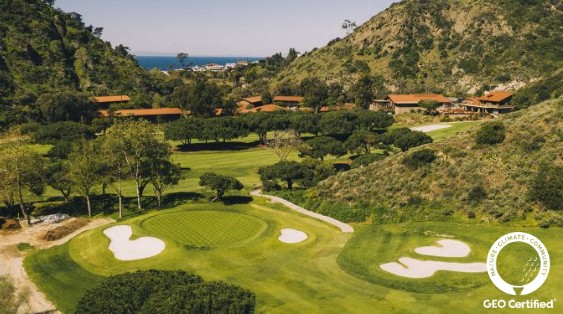
For almost 20 years, the Geo Foundation for Sustainable Golf has been dedicated to inspiring, supporting, and promoting sustainability and climate action in and through the sport of golf. I had the opportunity to meet Sam Thomas at the recent GCSAA Golf Industry Show in Orlando and talked with him about the concept of sustainable golf development. Sam is the Director of Golf Development & Renovation. He works closely with golf architects, developers, governments, and tourism bodies to promote sustainable development in golf. With over a decade of leadership in this area, Sam has guided numerous projects in both emerging and established markets, ensuring they maximize their positive environmental and social impacts. He is a chartered member of the UK Landscape Institute and holds an MSc in Golf Course Architecture, adding technical expertise to his role in sustainable golf development.
Based in North Berwick, Scotland the foundation has the mission of:
“Established with the sole purpose of helping accelerate sustainability in and through golf, GEO Foundation has been collaborating widely with partners from golf, government, NGO’s, business and science for over 15 years.”
They’ve worked worldwide, including the US, and count the PGA Tour TPC Venues among their clients.
When I asked Sam how they go about helping courses become more sustainable he provided a litany of focus areas. Geo maintains an “agenda” for sustainability, which includes (among others):
- Site Selection
- Resources/Water
- Chemicals
- Community Impact
- Public Relations and Social Outreach in the Community
- Recommended Practices
- Economic Practices
- The “Top 5” Moments
While other natural resources are required, the availability of water is critical. When advising a golf course development client, they assist in choosing the best source, how much is needed, what alternative sources can be accessed and consider the quality of water. Of course, treated wastewater is often an option and sometimes the need for desalinization exists. Much of this is part of the site selection process.
Chemical use is a big part of the opposition to many golf course projects. Thomas maintains that there are more chemicals used growing food than on golf courses. That said, he emphasizes that good PR is needed to improve the image of golf courses environmentally and Thomas thinks the golf industry could use science and data more effectively to develop more accurate messaging to the community.
Among the “best practices” Thomas recommends are decision making based on the local climate, a high focus on drainage, quality irrigation systems and the capture and use of rainwater for irrigation. He says that in many cases the lowest budgets can be the most sustainable and that he discourages the “over spending” and “over designing” that has contributed to what I often refer to as the “Space Race” in golf course development and renovation. Economically, Geo encourages managing grading efficiently, fitting the golf course to existing topography, maintaining fairway width at reasonable levels and designing bunkers effectively.
Thomas identifies “5 key moments” where (GEO Foundation) experiences in a golf development project’s timeline where economics and ‘sustainability’ come closest. They are:
- Site Acquisition – The right site can save lots of money in development
- Golf Course “Cake” – The most important ingredients are sand and water
- Staffing/Operations – Make the course a community enterprise
- Golf “Type” – Build the type of course that will fit the market it’s in
- Construction Arrangements – Make sure you build a team that can work well together
A golf course development (or renovation) project has lots of “moving parts”. Sustainability (both environmentally and economically) is a goal of all of them. Building the right team is essential and sustainability should be a focus from the start.
