

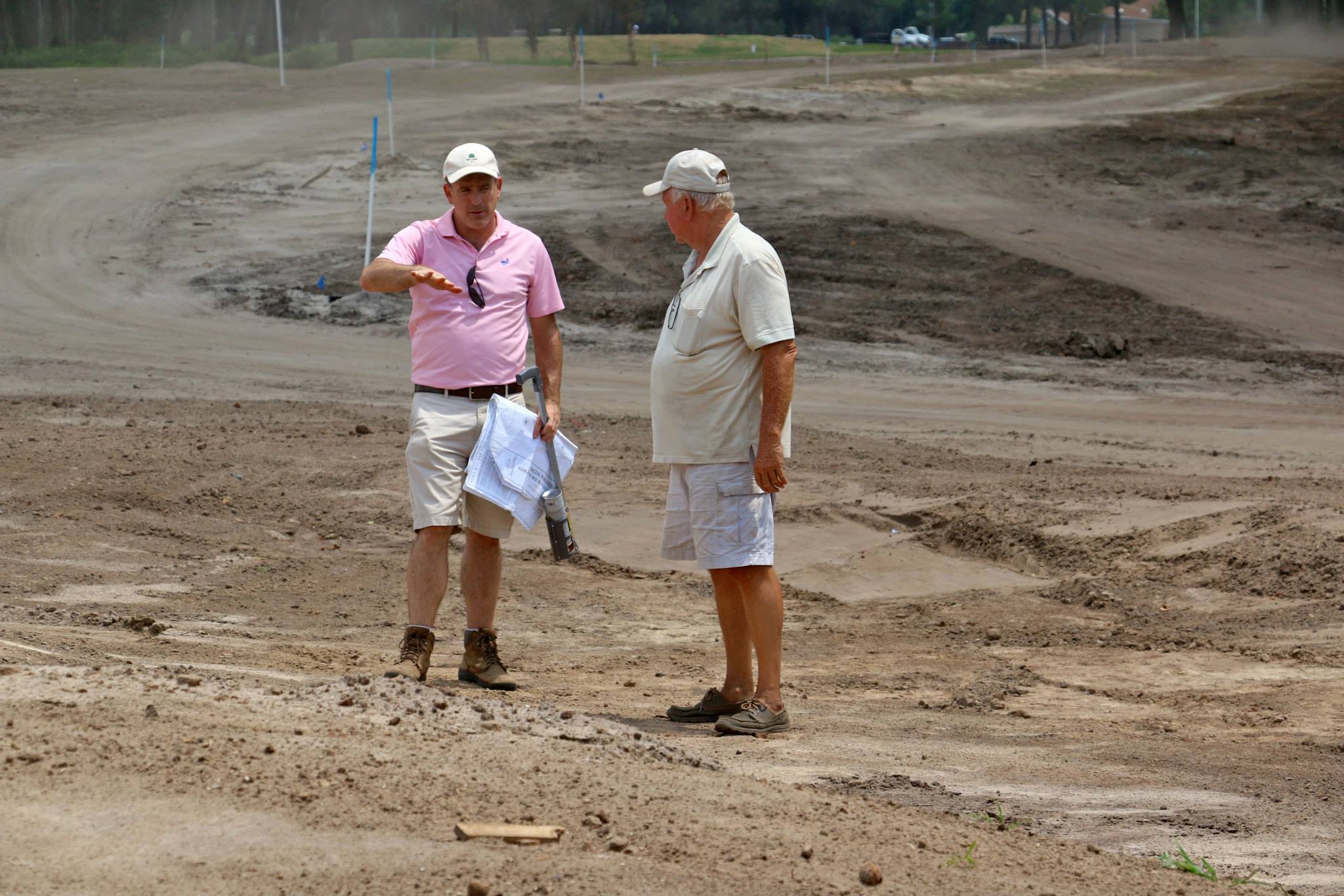
There have been many great books about golf course design written through the years. Offerings from George Thomas, A.W. Tillinghast, Donald Ross, Cornish/Whitten, Dr. Mike Hurdzan, Tom Doak, Bradley Klein and other familiar names come to mind. Recently, I attended a presentation by Pinehurst, NC based architect Richard Mandell about his book Principles of Golf Architecture that provoked some thought about the modern golf design process and concepts.
While Mandell’s book focuses mostly on the technical fundamentals of golf course design, I was particularly intrigued by his sensitivity to the economics of the ultimate product and posed some questions to him that focus on the economic feasibility and potential value of the subject course.
One thing I’ve always been intrigued by is what’s the first thing an architect asks of a potential client upon first contact. Since so many projects today are renovations, it’s incumbent upon the architect to provide some guidance and direction. Mandell says: “That direction starts with helping the club understand what their identity currently is and what they may want it to be (if it differs). That comes with evaluating their membership composition and its competition for those members. At some point in the process the delicate question is if a club has the resources to match their desired identity.”
When I asked which of the principles and elements stands out, he said the element of line since “that is the series of points which all designers begin with any creative medium” and “the Principle of Variety. Without Variety, a golf course is repetitive, boring, and stagnant.” Here is where Mandell acknowledges the fact that golf is a business, and that financial return is essential. He says “if a golf course lacks variety, it will most likely lack repeat play.” His chapter on the principle of Variety emphasizes the following formula: Strategy: Challenge = Options = Choices = Repeat Play. Makes sense to me.
What intrigued me the most about Mandell’s presentation was his ability to articulate, objectively, the somewhat subjective topics of playability and difficulty as they relate to golf course design.
I asked how one makes a golf course both “playable” and challenging at the same time. First, he defined “playability” as “the degree to which a piece of ground used for sports is in acceptable condition and suitable for playing on.” This makes most courses “playable, by definition. To Difficulty itself has two principles – Challenge & Penalty. The concept of being penal is simple. Miss a shot, be penalized. Mandell looks at “challenge” as “A hazard is to challenge, not penalize.” In other words, the fewer the hazards the better it is for the golfer to be truly challenged (look at Augusta National). Those hazards inspire the golfer to make a decision of some sort other than just simple survival. With golfers of varying abilities required for courses to be economically successful, Mandell advocates the concept of “Tee Shot Distance Equity, In a nutshell, it is a means to develop enough tee boxes for the varying talent levels so not only can golfers reach greens in regulation from their tees, everyone experiences the same shot in terms of club selection. For example, instead of everyone playing from 150 yards, everyone hits a seven-iron (from different distances).“

Mandell emphasizes that most golfers confuse playability & difficulty. He says: “When someone complains about something being unplayable they usually mean it’s too difficult for them. The better someone gets, the more “playable” a golf course becomes for them or the less “difficult” it becomes.” It’s critical to know who the golf course is intended for.
With renovation projects it’s often one goal to minimize maintenance costs as much as possible. This is done by focusing on where hand work can be replaced by machines and create features that appear hand-maintained but that can be done with machines.
Sometimes, a client will request something that just may not work – architecturally or economically. In those cases Mandell feels it’s his obligation to advise the client accordingly and objectively, sometimes despite the risk of losing the job. He’ll offer another approach, suggest an independent feasibility analysis or even walk away from a job. I can certainly say that through the years, the architects I’ve worked with have a keen interest in not only the “artistic” success of their projects but also want them to be economically successful. He says that approximately 50% of clients may initially resist his advice and 15-20% simply won’t change their minds after consideration.
I’ve always wondered if American Golf would ultimately reject “Augusta Syndrome” and become more receptive of the sometimes brown and imperfect conditions we encounter on golf pilgrimages to Scotland & Ireland. Mandell doesn’t think so, saying: “Some will but not in a sweeping fashion where golf can actually become economically sustainable, which it is not. Now that I’ve been in this business multiple decades, I am beginning to experience major trends. Many in the industry (architects, players, management groups, and media) talk a good game but at the end of the day it is a matter of the wow factor and what the “country club” represents, which is a high level of service that translates to high conditioning on the golf course side. My efforts at affordability and sustainability won’t ever garner the critical attention that other’s work does.” Mandell emphasizes the climatic differences between the UK and most regions in the US and notes that in the UK courses are “managed” while in the US courses are “maintained”. Seems like a subtle difference but the American golfer has been spoiled and Mandell mentions the golf course raters (Golf, Golf Digest, Golfweek) and the evaluation category of course conditioning that is part of the rating process. (Note: I am a Golfweek Rater)
The last question I posed to Mandell was whether he envisions a future movement toward more affordable golf courses. His response was that as long as the media represents the golf world through the prism of professional golf it will never happen. He highlighted a project where they spent $12.5 million at Bobby Jones in Sarasota on an 18-hole restoration, nine-hole short course, 101-acre park with a wetland, and a 25-acre practice facility. He says “It can be done for less than $20 million. As far as costs declining or stabilizing, I would like to think that is a possibility but as long as the cost of fuel and materials continue to rise (as it always does) it’s hard to see that happening. It’s really about needs, wants, and desires. If we as a golfing society accept the needs, minimize the wants, and eliminate desires then maybe costs can stabilize or decline.” Mandell suggested to me that maybe we don’t need $3 million+ irrigation systems and can effectively use less costly, single-row systems, that “push-up” or “California” greens can reduce construction costs while functioning effectively and that better defining tree clearing areas can save dollars and help control the cost of golf.
From my perspective as a real estate consultant/appraiser some of these concepts can help to bring the cost : value relationship more into balance when considering the economic feasibility of both new and renovation projects.
Golf course design is a most intriguing topic. It will always be a vigorous discussion amongst those of us who are avid golfers. Mandell does a great job in this book of bringing some objectivity to an inherently subjective topic. Interesting reading for sure.
