

Weather has a huge impact on our lives. Many choose where they live based on the climate and daily conditions often dictate our activities. Travel, by air, car or sea is also subject to weather conditions and severe weather events, like hurricanes, tornados, extreme rain and snow events and wind can create extensive property damage costing billions of dollars. The economic fortunes of golf courses are securely tied to climatic and daily weather conditions both from an agronomic perspective and the habits of most golfers desiring to play in pleasant conditions. Measuring that impact has been a challenge for years. Recently, I had the opportunity to chat with Tom Gallagher and Dave Downey of Flash Weather AI and learn more about historic climatic data and weather forecasting as it relates to the golf industry.
As a longtime pilot, I have a basic understanding of weather and forecasting and how it affects any given flight. As a golfer and golf industry consultant, my focus is on the following questions:
- How can “typical” weather be measured for a specific location and compared to conditions over the course of a given year to determine whether conditions in any given year were typical, better than typical, or worse than typical?
- How can “golf conditions” be defined?
- What role does precipitation have in golf weather analysis?
- Is wind a major factor in golf weather analysis?
- In what ways can golf courses use weather and climatic data?
- What are “Playable Hours” and the how does the psychology of booking tee times impact course economic performance?
- How accurate are long range forecasts?
According to Gallagher, not surprisingly, golf weather is defined by a combination of temperature, precipitation, cloud cover & wind. He says: “These conditions affect comfort, safety, course conditions, and booking behavior, making them measurable drivers of rounds played and overall utilization. Unlike binary metrics such as rain or no rain, golf weather exists along a spectrum, where marginal conditions can materially reduce participation even when play remains technically possible.” I’ve always wondered if golfing weather couldn’t also be categorized in the same manner as aviation weather, i.e. Visual Flight Rules (VFR), Marginal Visual Flight Rules (MVFR), Instrument Flight Rules (IFR) and Low Instrument Flight Rules (LIFR). These classifications make it easy for pilots to know whether conditions are favorable for a planned flight depending on pilot qualification/experience and equipment (aircraft) used for the mission.
Conditions considered compatible with golf vary due to location and golfer enthusiasm, but generally golfers seek warmer temperatures, limited (if any) precipitation and lighter winds. As an example, Gallagher says that 20 MPH wind gusts begin to impact play whereas 30 MPH gusts can cause unplayable conditions and not be enjoyable. He also notes that in warmer climates, cloud cover can be welcome, as a way of moderating the effect of higher temperatures. One challenge is that “golf weather” varies from location to location and season to season. For instance, a cool (50’s), cloudy day with 20 MPH winds in July in Scotland is considered a good day for golf while in Philadelphia a typical golfer may decide to sit the day out.
Nobody truly seeks to play when it’s raining (though we often do) but more importantly to a course’s economics is the impact of recent historical precipitation. Gallagher says that “Rainfall over the prior 24 to 72 hours can materially affect course playability even under otherwise favorable weather conditions. Soil moisture indicators and cumulative rainfall provide a way to quantify these effects, although their impact is highly site-specific and influenced by soil composition, drainage infrastructure, and course design. As a result, recent precipitation functions best as a modifier rather than a standalone predictor of playability.” Flash collects data on things like volumetric water content, near and long-term precipitation probabilities with ranges of least probable to most probable to location forecast. Among the reasons drainage is such an important factor in golf course construction is the impact on how long a golf course might require restrictions on cart traffic, or even opening the golf course after a rain event, even on ideal weather days. Conversely, a course’s ability to handle drought conditions can also impact how play is managed.
It’s long been my conclusion that using the concept of “playable hours” can be deceiving since poor conditions in the morning, according to many course operators, can cause some golfers to cancel tee times even when the afternoon forecast is favorable and turns out to be accurate.
We all know that even the best players consider wind the most significant factor in impacting their ability to score well. Gallagher shares that “As wind speeds increase, course difficulty rises and golfer comfort declines, leading to higher cancellation rates. These effects vary by course design and regional norms, but booking data consistently shows increasing sensitivity to windy conditions.” Flash has historical wind data available that can be used to analyze long-term analysis of rounds played and course utilization trends.
There are many ways golf courses can use detailed weather and climatic data to enhance management. These range from Operations and Rounds Management (revenue forecasts, tee sheet and staffing optimization, play management & safety), to course maintenance (disease management, irrigation, labor, frost delays) and business strategy (pricing, communication & capital planning). FlashAI has developed the Golf Playability Index (GPI), as well as compiling historical data so that weather conditions from one year to the next can be compared and so that a “normal” weather year for specific locations can be defined and performance can be measured against climatic norms. This will allow golf courses to keenly understand the impact of abnormal weather on economic performance.
GPI is calculated using 10 different weather parameters all weighted on a scale, then aggregated. A parameter such as frost would result in a score of 0 during the timeframe of formation to dissipation since courses will not allow play on frost due to potential turf damage. These parameters are scaled not only based on severity, but also operational impact. While the GPI right now gives a score of 0-100, future versions will allow users to see what parameters are impacting that score. GPI also considers geography. The current version data is based on 1x1km, meaning local effects are taken into account.
GPI converts complex weather into a single score (0-100) that replaces educated guesswork with decisive action. It measures all the factors that materially impact play, safety, pace and agronomics. These include temperature, heat stress, precipitation, lightning, wind, frost & snow. Right now, GPI can be used to aid courses with dynamic pricing, predict best and worst days in advance and reduce refunds and booking disputes. As more historical data is harnessed the ability to measure norms and extremes will also help golf courses and clubs determine the impact of weather on a given period’s economic performance. It’ll also help with projecting normalized cash flows for business forecasting and valuation exercises.
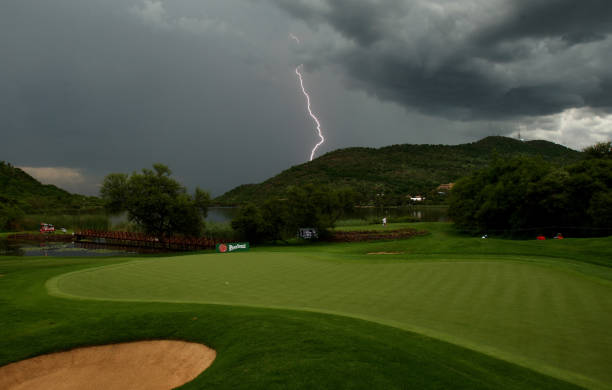
Safety, of course is of primary importance and lightning is probably the single biggest safety risk on golf courses. FlashAI is the only company in the world able to predict lightning strikes, up to an hour in advance at up to 99.6% accuracy to the square kilometer.
One of the most interesting elements of the golf/weather analysis is the reliance by some on a calculation of “playable hours” as a metric for determining whether a given period was normal, better than normal or worse. I’ve always been a bit skeptical of this measure and Gallagher explained it this way: “Playable hours oversimplifies how golfers respond to weather. Booking and cancellation behavior is often driven by forecast perception rather than actual afternoon conditions. Poor weather early in the day, or even the appearance of unfavorable conditions, can suppress participation for the entire day. As a result, models that focus solely on playable time frequently overestimate actual utilization.”
Like lots of golfers, when I have a golf trip planned in advance, I’ll glance at the long-term forecasts, despite my wife’s (and others) assertions that predictions a month or more in advance are useless. Gallagher says that while such forecasts can be useful for broader trends (warmer than normal or wetter than normal), they can’t be reliable for day to day operations.
Golfers and courses alike can use detailed weather information to plan effectively. Like many sciences, meteorology is continually advancing.
