

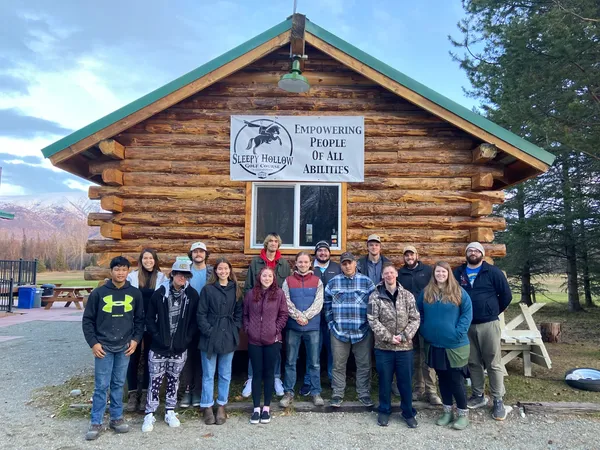
Earlier this summer while visiting Alaska, I happened upon a very interesting golf course facility, Sleepy Hollow Golf Course in Wasilla, about an hour’s drive from Anchorage. Though only a 9-hole, par 3 course what I learned while onsite from course manager Allie Nadon is the great work they do there through the Nadon Family Home. The mission of Nadon Family Home (NFH) is to empower individuals of all abilities by creating inclusive employment and skill development opportunities, providing supportive residential services, and fostering meaningful community connections. Sleepy Hollow (as well as Midnight Sun GC in Fairbanks) is an integral part of serving their mission. I thought it would be interesting to learn more about how these golf facilities serve the community in a less conventional way and posed some question to Allie.
Allie Nadon plays a vital role in connecting individuals of all abilities with the broader community. As the Community Connection & Engagement Coordinator at Nadon Family Home, she creates inclusive events, learning experiences, and social opportunities that empower individuals and promote independence, in addition to being the operations coordinator at Sleepy Hollow. Allie is a certified Employment Specialist who works to connect individuals with job opportunities that align with their strengths, while also meeting the needs of local employers. She uses creativity and job carving strategies to help ensure long-term success and meaningful growth for both the employee and the workplace.
With NFH’s focus on those with challenges I asked why golf is a good platform for the goals of NFH. She responded by saying that “A golf course is the perfect setting to support this mission because it provides year-round employment with a wide variety of jobs that can be tailored to each person’s skills and interests.” Specifically, she highlighted the many diverse skills needed at golf courses, such as people skills (for dealing with the public), culinary skills, agronomic skills, mechanical skills and more. Golf courses are truly very complex operations. NFH clients learn many of these skills and others at the golf course that they can carry to future careers.
In particular, NFH serves individuals with both intellectual and developmental disabilities and provide opportunity, which is often the factor most lacking. Because of the connection with NFH, both Sleepy Hollow and Midnight Sun share the goal of being self-sustaining and are able to focus on that instead of just profitability. The NFH model also affords employees the perk of free golf and they encourage participation in Special Olympics Golf which further encourages community involvement and can potentially create new golfers.
When I asked for an example of success stories, Nadon mentioned that “Each employee with a special ability works alongside a job coach for support. One of our employees has grown so much in his knowledge and independence with greenskeeping that he now serves as a job coach himself, helping others gain the same skills and confidence.” Of the 20 staff members at Sleepy Hollow, 8 have intellectual or developmental disabilities and all play a vital role in the operation. At Midnight Sun, an 18-hole facility which is the northernmost course in the US, the numbers are greater.
NFH was founded in 2011 by Ray and Stephany Nadon. They were inspired to help a family friend whose son had intellectual disabilities gain more independence during the major transition from high school to adulthood, with the hope that he could one day live independently. It began with a single group home in Anchorage and has since expanded to Fairbanks and Wasilla, now operating 12 group homes and offering top-tier supported employment opportunities as well as day habilitation programs. NFH purchased Sleepy Hollow in 2020 and Midnight Sun in 2022.
As we all know, golf does much as a vehicle for promoting charitable contribution. What struck me about Sleepy Hollow was how through thinking “outside the box” it might be possible for golf courses and clubs to partner with similar organizations in a way that could not only give back, but also preserve more golf courses that could continue to operate even if not profitable and to help contribute to the community by providing a variety of services and training making a positive impact on the lives of those who need help the most. A noble idea.
