

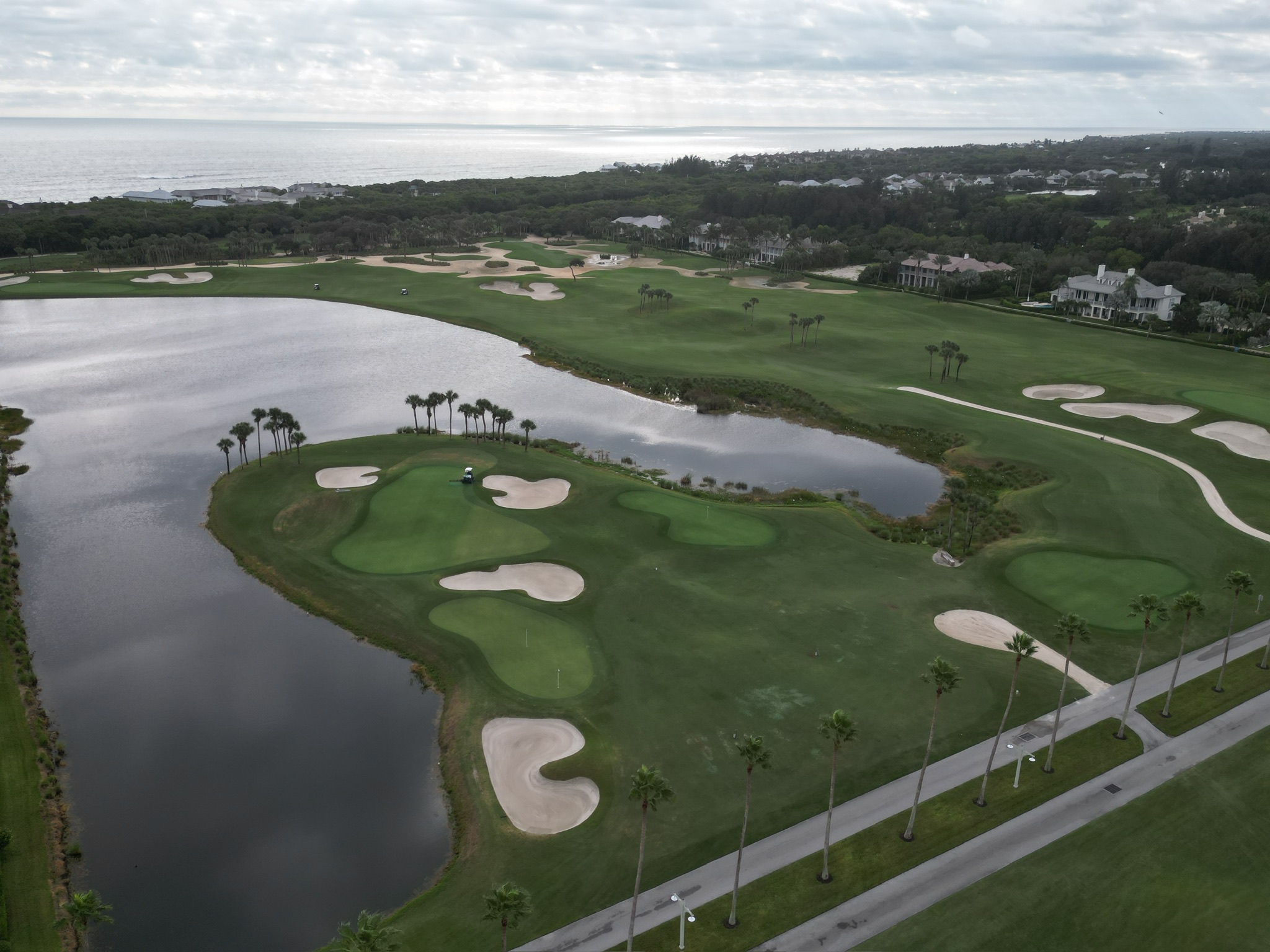
Among the areas that often escapes necessary attention at golf courses is pond maintenance. There are often more pressing issues. At a recent industry conference I met Casey Cittadino & Nate Watkin from SOX Erosion Solutions and posed some questions about the risks of overlooking potential erosion of pond and creek banks on golf courses and how it impacts the surroundings.
They indicated that erosion happens slowly over time due to environmental factors such as rainfall, fluctuating water levels, and improper herbicide applications. What often happens is that maintenance gets deferred until a bigger issue forces action — whether it’s erosion, bank failure, or drainage problems. That’s when the true cost becomes much more than just financial — it can also impact playability, safety, and even environmental compliance. Cittadino says that “best management practices for pond maintenance include, but are not limited to, buffer zones along the slope of the lake bank, proper use of chemicals to reduce algae blooms, monitoring lake banks for erosion, and keeping water bodies clear of debris.“
Of particular interest to me was what it costs to include regular maintenance of ponds, banks and streams. They suggest between 1% and 3% of the total operating budget (maintenance) depending on the size, location and geography of the property. Thus, a property with a $1 million budget should allocate up to $30,000 per year for pond maintenance.
Cittadino urges proactive maintenance which he says is always more cost-effective than reactive fixes. “Courses should implement routine inspections of banks and water features, monitor for early signs of erosion, and have a plan in place for stabilization before failure occurs. Partnering with experienced environmental engineers or erosion control specialists can help courses design a custom strategy that fits their unique challenges.” He adds: “Smart clubs will look at bank and pond maintenance the same way they approach greens or bunker maintenance — as an essential line item, not a luxury.”
Among preventive initiatives is a new product. SOX is getting ready to launch a new product line — SOXPRO — specifically designed to reduce and filter chemical runoff from stormwater before it enters ponds or streams. This is a big step forward in helping courses not only meet environmental standards but actively improve the health of their ecosystems. By stabilizing the banks and filtering runoff, they help mitigate the negative impact of fertilizers, pesticides, and other chemicals commonly used on the course.
Among the things to be considered is bank stabilization. It’s not uncommon to read stories about golfers retrieving balls only to slip on a steep bank and fall into a pond. Stabilizing those banks would help any person get in and out of the pond with little effort. An eroded lake bank would be more vertical and extremely unstable for a person to climb out of the water. This concern is elevated in those areas where alligators or other wildlife might cause a danger. SOX explains that their system is comprised of 5 parts (both synthetic and natural): anchors (typically wooden earth stakes), SOX high density poly-ethylene technical mesh, multifilament polypropylene rope, fill (sandy material with organics), and vegetation (sod, springs, seed). “Our system is tethered to the eroded embankment, stabilizes the earth and is vegetated“, says Cittadino.
When I asked what are the economic benefits of preventive erosion control, they listed reduced liability, improved water quality, improved aesthetics and a stable environment for vegetation growth. SOX claims they can stabilize any earthen environment while allowing vegetation to grow. When vegetation is present from the top of a bank down to the water’s edge, it naturally filters the runoff from the golf course. The filtration process reduces algae blooms which then will in turn reduce inputs. I also noticed on their website that they mention “beautiful bunkers”. While not promoting a bunker liner they point out that often times bunkers are situated near a water body and when our system is deployed around that bunker, it creates an enhanced visual for the golfer of the bunker.
I asked SOX how they can contribute to enhancing the value of any golf course. They responded with some case studies, and by saying: “When our system is deployed on a golf course, it will reduce liability to the golf by keeping golfers and employees safer, turns water hazards into water features, restore original site lines and architecture intention, and regain lost, valuable land.”
