

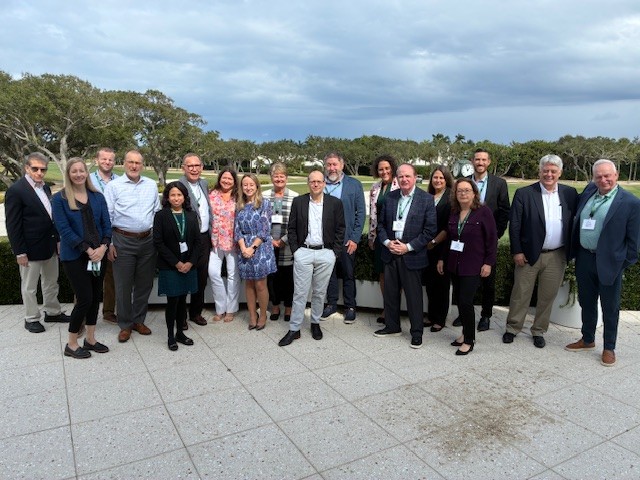
Earlier this week, I was privileged to be invited to participate as a presenter and attendee at the annual Club Tax Network Conference (CTN) in North Palm Beach, FL. CTN is an association of accounting firms and law firms serving the Private Club Industry with an appreciation for the role that state and federal taxes play in the overall equation. Their stated purpose is to benefit Private Clubs through the education and support of their Professional Advisors. In today’s world of specialization, auditing and accounting for clubs requires specific expertise, just like real estate valuation, consulting and brokerage. It was truly a privilege to present to this esteemed group of club industry professionals, alongside Ray Cronin of Club Benchmarking, Carl Mistretta of First Tee Florida Gold Coast and attorney and CTN member Robyn Nordin Stowell of Spencer Fane LLP.
Combined with spirited discussions on topics ranging from the use (or lack thereof) of the Uniform System of Financial Reporting for Clubs (USFRC), fraud at clubs, the need for competitive board elections, member onboarding, voting procedures, By Laws issues, spending restrictions, alcohol at board meetings and more it was anything but boring to gain these professionals’ perspectives on a variety of issues impacting the private club industry.
Among the most interesting topics discussed was that annual audits of clubs are NOT designed to identify fraud, and in fact don’t search for it. Such audits are simply done to not only summarize the club’s finances, but more directly to simply ensure that accounting procedures are properly followed. If one suspects fraud, whether from staff, members or club leaders, the accountants in attendance suggested retaining a private investigator or forensic accountant. It was universally agreed that, at member-owned clubs, financial reconciliations need to be done with the club’s controller, GM and treasurer in the room so that appropriate oversight exists.
Of particular interest to me was the lack of widespread adherence to USFRC. When I asked “why not”, I learned that apparently USFRC is not consistent with Generally Accepted Accounting Principles (GAAP). USFRC was developed by the Club Managers Association of America (CMAA) and while USFRC is useful to us in the valuation/consulting world, apparently it’s not consistent with what the accountants require.
Stowell, in her legal issues presentation stressed the need for club boards to provide transparency on votes taken, at least to the point of recording the procedures employed. Additionally, she advised that the texts and emails of board members are discoverable and recommends all board members use a club email address for all club-related communications to avoid other emails being exposed.
Mistretta, a gentleman with a most interesting background, including golf course design with the Jack Nicklaus group shared information on the golf marathon charity event which helps fund First Tee scholarships and is supported by numerous clubs in the region. they’ve raised more than $1 million.
Cronin, always the purveyor of fascinating data and statistics, shared insight from 15 years of financial and business model research offering recommendations for clubs to achieve success. Cronin de-emphasizes profiting from food & beverage (<10% of member-owned clubs make a profit) and claims that those that do are the weakest clubs. He focuses on balance sheets and net equity which favors clubs that have reinvested in facilities over those that have allowed facilities to deteriorate and have become less desirable. In other words the board focused on making the club better (rather than cheaper) are the strongest. Cronin says that the strongest clubs are those emphasizing the member experience as opposed to efficiency.
My feeling is that clubs still need to be sensitive to their culture and their market but do agree that maintaining and enhancing quality of the member experience is critical.
My presentation addressed valuation issues, mostly related to those clubs considering or embarking on a conversion from 277 (taxable, for profit) status to 501 C7 (tax exempt, not for profit) status.
All in attendance agreed that “happy” clubs are those where the board governs, the managers mange and the members enjoy the club. Dysfunctional clubs are often led by a successful businessman hell bent on “not wasting money”, the board tries to artificially maintain low dues and good managers leave due to micromanagement. Cronin sees a correlation between higher entrance fees and club success. I guess the question is whether the club is successful because of a higher entrance fee or if the fee is high because the club is successful. He stresses (and I agree) that clubs are a hospitality enterprise. It was also universally agreed by those in attendance that individuals who aggressively seek board and leadership positions in the club should be disqualified from same.
